

In short: On 1 October 2026, Google updated its official guidance on AI-generated content. It now says human fact-checking and review of all AI-written content is critical before publishing, including page titles, meta descriptions, structured data and image alt text. Google isn’t banning AI content, but if you’re using ChatGPT or Gemini to write your website, here’s what changed and a simple five-step check to stay on the right side of it.
What Google changed on 1 October
Google’s Search Central documentation is the official guidance it gives website owners. On 1 October 2026, it updated its page on using generative AI content with three new sentences in the section on accuracy and quality. In plain English, they say:
- AI models don’t look facts up. They generate likely-sounding text, which is why they can produce confident mistakes, often called “hallucinations”.
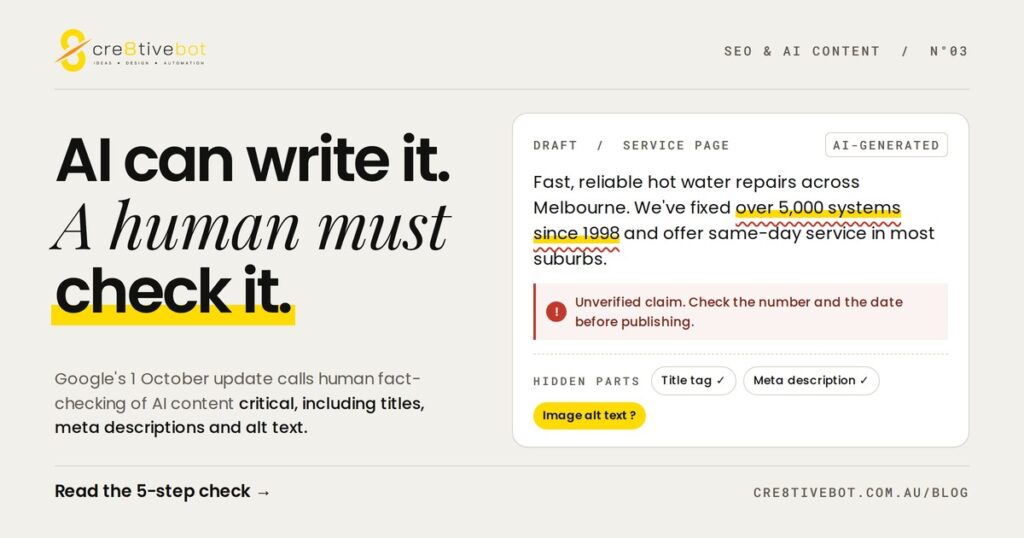
- Human review is critical. Google says all AI-generated content should be manually fact-checked and reviewed for accuracy and trustworthiness before it’s published.
- It’s not just the article. As PPC Land reported, the review covers machine-written page titles, meta descriptions, structured data and image descriptions too.
Google also updated its guide to creating helpful, people-first content. It now describes producing large amounts of AI text without manual oversight or curation as “little to no effort”, which is a mark of low-quality content in Google’s quality guidelines.
What it doesn’t mean
This is a documentation update, not a new penalty. Google’s changelog says it was made to bring the guide in line with its Search Quality Rater Guidelines, and nothing in it ties the change to a specific algorithm update. Using AI to help write content is still allowed. What Google cares about is the result: is the content accurate, original and genuinely helpful to the people reading it?
Why the timing matters
The update arrived one week into Google’s September 2026 spam update, which finished rolling out on 8 October. And looking ahead, a widely followed prediction model by SEO analyst Dan Taylor puts the chance of another Google update within 30 days at 96.8%, and he expects it to target scaled, low-value AI content. Google hasn’t confirmed any update, so treat that as a forecast, not a fact. But the direction is clear: content published without real human effort is a growing risk.
Is your website at risk?
You’re most exposed if any of these sound familiar:
- Your service pages or blog posts were generated by AI and published with little or no editing.
- You created many near-identical pages, such as one page per suburb with only the suburb name changed.
- Your page titles, meta descriptions or image alt text were bulk-generated and never checked.
- Your content includes statistics, prices, regulations or claims that nobody has verified.
None of these automatically means a ranking drop. But they’re exactly the patterns Google’s guidance describes as low effort.
The 5-step AI content check before you publish
1. Fact-check every claim
Check every number, price, date, law and statistic against a reliable source. AI tools regularly invent figures that look perfectly plausible. If you can’t verify it, cut it.
2. Add what only you know
AI can’t describe your real projects, your local customers or the problems you see every week. Add examples, photos, results and opinions from your own experience. That’s the originality and effort Google’s guidance is looking for.
3. Review the hidden parts too
Read your page titles, meta descriptions and image alt text with the same care as the page itself. Google’s update names them specifically. In WordPress, an SEO plugin such as Rank Math shows these in one place for each page.
4. Don’t mass-produce near-identical pages
A page for every suburb with only the name swapped is a classic low-effort pattern. If you serve several areas, write fewer, better pages with genuinely local detail: projects you’ve done there, travel times, local conditions.
5. Have a person sign off
Before anything goes live, someone who knows the business should read it start to finish and ask: is this accurate, is it useful, and would I be happy for a customer to read it? If the answer is no, it isn’t ready.
Frequently asked questions
Does Google penalise AI-generated content?
Not for being AI-generated. Google’s guidance focuses on quality, accuracy and helpfulness, however the content was made. Low-effort content can perform poorly whether a person or a machine wrote it.
Do I need to label content as AI-written?
Google’s search guidance doesn’t require a label on every page. What it does stress is accuracy and trustworthiness, so the human review step matters far more than a disclaimer.
Can I still use ChatGPT for my website?
Yes. It’s a useful tool for outlines, first drafts and ideas. Treat what it writes as a starting point, then fact-check it, add your own experience and have a person approve it before it goes live.
How do I know if my existing content needs work?
Start with your most important pages: your homepage and main service pages. Check them against the five steps above, and run our free audit to find technical and content issues quickly.
Check your website today
Run our free SEO and AI audit to see how your site scores in about 10 seconds. If your content needs a proper review or rewrite, our Melbourne team offers content marketing and SEO services for Australian small businesses. Book a free discovery call to talk it through.
More on AI search: Google Search is now AI-first and is your website ready for ChatGPT search?