

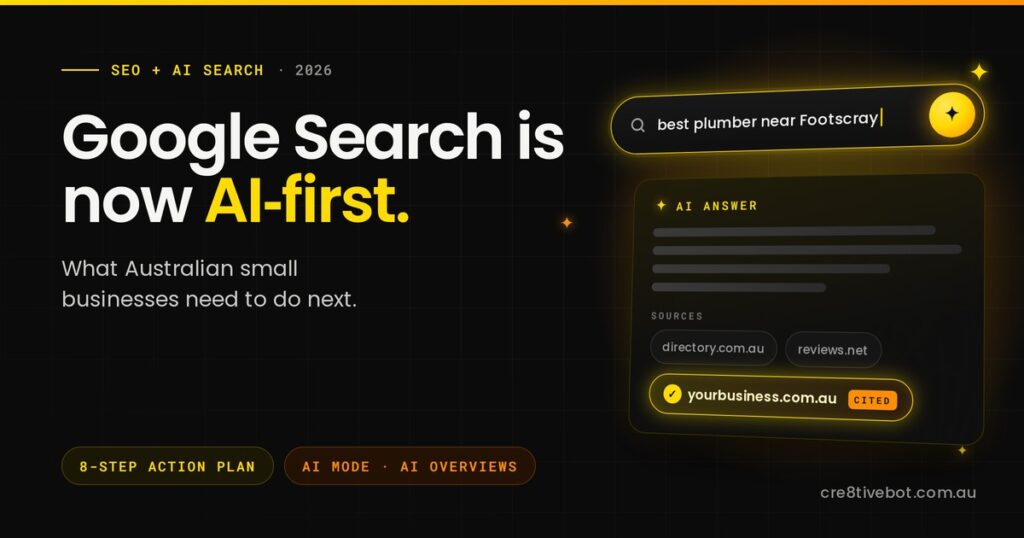
In short: Google Search now puts AI answers first. AI Overviews and AI Mode summarise the web and cite a handful of sources, so being one of those cited sources matters as much as ranking in the classic list. The good news for Australian small businesses: the things that earn citations are clear answers, accurate business details, genuine expertise and a fast, well-built website. Below is what changed, what it means, and an eight-step plan you can start this week.
What changed in Google Search
AI in Google Search has arrived in stages:
- 2024: AI Overviews (the AI summary at the top of many results) launched in Australia.
- October 2025: AI Mode arrived in Australia: a conversational search mode that answers long, detailed questions and cites its sources.
- May 2026 (Google I/O): Google reported that AI Mode has passed a billion monthly users, with queries more than doubling every quarter. It launched a redesigned AI-powered search box, made Gemini 3.5 Flash the default model in AI Mode worldwide, and let people move straight from an AI Overview into an AI Mode conversation.
- October 2026: Google announced that AI Overviews and AI Mode now show more links, placed higher in AI answers, and it is testing a block that highlights the official pages a task needs.
Classic search results still appear. But for a growing share of searches, the first thing your customer sees is an AI-written answer, and the businesses it mentions get the attention.
What it means for small businesses
1. Being cited is the new page one
In an AI answer, only a few sources are named. If your business is not one of them, you are invisible for that search, even if you rank on page one underneath. Industry data shows how common these answers have become: Ahrefs found AI Overviews on roughly 83% of US desktop searches for branded keywords in late September 2026.
2. Customers ask longer, more specific questions
Google says people using AI Mode type questions two to three times longer than traditional searches. Instead of “plumber Melbourne”, it is “emergency plumber near Footscray who can fix a burst pipe tonight and gives a fixed price”. Pages that answer specific questions clearly are the ones AI can use.
3. Fewer clicks, but better ones
Some searches now end without a click because the answer is on the page. The clicks that do happen tend to come from people further along in their decision. That makes your website’s job (turning a visit into an enquiry) more important, not less.
4. Trust signals are being checked
Google’s AI is getting better at spotting self-promotion. Industry analysis suggests it now discounts “best of” lists where a business ranks itself first, and research on ChatGPT shows it tends to cite primary sources. Genuine expertise, real data and consistent details win.
What has not changed
Google is still where Australians search. Statcounter data reported for May 2026 puts search at around 91% of the market against roughly 9% for social and a small share for AI chatbots, as summarised in this Australian analysis. AI answers are built from Google’s own index, so the fundamentals of good SEO still apply: a fast, crawlable website, helpful content and a strong local presence. AI simply rewards them more sharply.
Your 8-step action plan
Step 1: See how AI sees you today
Open Google, switch to AI Mode, and ask the questions your customers ask: “best [your service] in [your suburb]”, “how much does [your service] cost in Melbourne”, “who can [solve the problem] this week”. Note who gets mentioned. Then run our free SEO and AI audit to check your site’s technical health and AI search readiness in about 10 seconds.
Step 2: Answer real questions, clearly and early
Turn your customers’ questions into page headings, and answer each one in the first sentence or two beneath it before adding detail. Add a short FAQ section to each service page. AI tools quote clear, self-contained answers; they skip vague marketing copy.
Step 3: Make your Google Business Profile complete and consistent
Your business name, address, phone number, hours and services should match exactly across your website, Google Business Profile and directories. Add photos, choose accurate categories, and keep your hours current, including holiday hours. Inconsistent details make AI less confident about recommending you.
Step 4: Add structured data
Structured data (schema markup) tells Google and AI tools precisely what your business is, where you operate, your hours, services and FAQs. On WordPress, an SEO plugin such as Rank Math can handle most of this. It is invisible to visitors but easy for machines to read.
Step 5: Publish first-hand content AI can’t get anywhere else
Share what only you know: real project examples with results, local pricing guides, before-and-after case studies, common problems you see in your area and how you solve them. Avoid thin “top 10” lists and self-ranking comparisons. Original information is what earns citations.
Step 6: Keep your site fast and open to AI
Slow, broken or hard-to-crawl pages are less likely to be used. Check that your site loads quickly on mobile, that important pages are indexable, and that you aren’t accidentally blocking search or AI crawlers in your settings. Our free audit flags many of these issues.
Step 7: Earn mentions beyond your own website
AI tools look for confirmation from other sources. Collect Google reviews regularly, list your business in reputable Australian and industry directories, join your trade association’s member listing, and look for local media or community mentions. Each one makes your business easier to verify and recommend.
Step 8: Measure what matters now
Rankings alone no longer tell the full story. Track enquiries, calls and bookings. Use Google Search Console for search performance, and add Bing Webmaster Tools, which now groups AI search queries into topics. And if your ChatGPT referrals seemed to drop in October 2026, check your analytics: analysts found that many ChatGPT links briefly lost their tracking tags, so those visits were counted as “Direct”.
Frequently asked questions
Is SEO dead now that Google uses AI?
No. AI answers are built from Google’s search index, so SEO is how you get into them. What has changed is the goal: you want to be cited in the answer, not just listed beneath it.
Can I pay to appear in AI Mode answers?
Google is testing ads in some AI experiences, but the organic citations in AI answers can’t be bought. They’re earned through clear content, trustworthy details and a strong reputation.
How long does it take to see results?
Quick wins, such as fixing business details, adding FAQs and structured data, can help within weeks once Google recrawls your pages. Building reviews, mentions and original content is an ongoing effort that compounds over months.
Do I need to do anything different for ChatGPT?
Mostly no. The same foundations help across Google AI Mode, ChatGPT, Gemini and Copilot: clear answers, accurate details, original information and a site search engines can easily crawl.
Want to know where you stand?
Run our free SEO and AI audit. It checks 40+ ranking factors plus your AI search readiness in about 10 seconds. If you’d like help acting on the results, our Melbourne team offers SEO services and AI SEO for Australian small businesses. Book a free discovery call and we’ll show you what to fix first.