
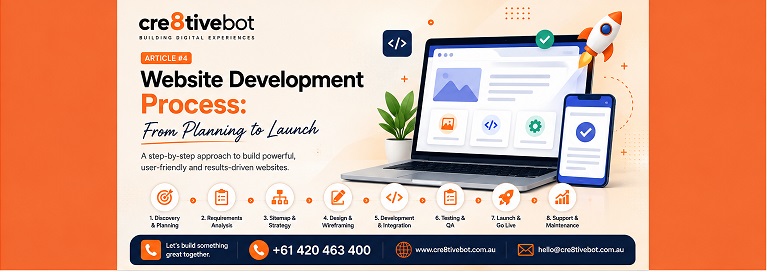
Website Development Process: From Planning to Launch
Building a professional website involves much more than choosing a template and adding a few pages. A successful website requires careful planning, strategic design, technical development, testing and ongoing improvement. Understanding the website development process can help Australian businesses make better decisions, control project costs and create a website that supports long-term growth.
Whether you need a small business website, WordPress website, Shopify store, WooCommerce eCommerce website or a fully custom platform, following a structured development process can make the project more efficient.
Cre8tivebot provides professional website development services for Australian businesses, helping organisations turn their ideas and business requirements into functional, user-friendly and scalable websites.
What Is the Website Development Process?
The website development process is a series of stages used to plan, design, build, test, launch and maintain a website.
Although every project is different, a professional website development process generally includes:
- Discovery and planning
- Requirement analysis
- Website strategy
- Sitemap and information architecture
- User experience planning
- Website design
- Platform selection
- Website development
- Content integration
- SEO implementation
- Testing
- Website launch
- Post-launch support
- Ongoing maintenance
The complexity of each stage depends on the size and purpose of the website.
Step 1: Discovery and Planning
The first stage is understanding what the business actually needs.
Before development begins, the website development team should learn about the business, target audience, products or services, competitors and objectives.
Important questions may include:
- What does the business want to achieve?
- Who are the target customers?
- How do customers currently find the business?
- What products or services need to be promoted?
- Does the business need eCommerce functionality?
- Are online bookings required?
- Does the website need third-party integrations?
- What features may be required in the future?
For example, a local Australian construction company may primarily need service pages, project galleries, enquiry forms and location pages, while an online retailer may need product catalogues, payment gateways, shipping integration and inventory management.
Good planning helps prevent unnecessary development work later.
Step 2: Define Website Requirements
Once the objectives are understood, the specific website requirements can be documented.
These requirements may include:
- Number of pages
- Website functionality
- Content management system
- eCommerce requirements
- Customer accounts
- Contact forms
- Booking systems
- Payment gateways
- CRM integration
- API integration
- Blog functionality
- Search functionality
- Product filters
- User dashboards
Clearly defining requirements helps establish the project scope and provides a better basis for estimating website development costs.
It also helps prevent a common problem known as scope creep, where additional features are continually added after development has started.
Step 3: Create the Website Strategy
A website should have a clear purpose for every major page.
For a service-based business, the strategy may focus on generating enquiries. For an eCommerce business, the objective may be increasing online sales. For a corporate website, the focus may include brand awareness, customer education and lead generation.
The strategy should consider:
Audience: Who will use the website?
Purpose: What should visitors do?
Content: What information do they need?
Conversion: What action should visitors take?
Search: What topics and keywords should the website target?
A clear strategy provides direction for the design and development stages.
Step 4: Create the Sitemap
A sitemap represents the structure of the website and shows how pages are organised.
For example, a business website might have:
Home
→ About Us
→ Services
→ Service 1
→ Service 2
→ Service 3
→ Industries
→ Projects
→ Blog
→ FAQs
→ Contact
An eCommerce website may have:
Home
→ Shop
→ Category
→ Product
→ Cart
→ Checkout
→ My Account
→ About
→ Contact
→ Blog
A well-planned website structure makes navigation easier for visitors and helps search engines understand the relationship between pages.
Step 5: Plan the User Experience
User experience, commonly called UX, focuses on how visitors interact with the website.
A good website should make it easy for users to find information and complete important actions.
UX planning can consider:
- Navigation
- Page layout
- Content hierarchy
- Buttons
- Forms
- Search
- Mobile usability
- Checkout experience
- Accessibility
- Calls to action
For example, if a business wants more quote requests, the website should make the quotation process simple and easy to find.
Step 6: Website Design
After planning the structure and user experience, the visual design can be developed.
Website design may include:
- Brand colours
- Typography
- Images
- Graphics
- Page layouts
- Buttons
- Navigation menus
- Forms
- Icons
- Mobile layouts
The design should reflect the business brand while remaining practical for users.
A visually attractive website isn’t necessarily effective if visitors cannot find information or understand what the business offers.
The best website designs combine appearance with usability and clear business objectives.
Step 7: Choose the Right Development Platform
Selecting the right technology is an important part of website development.
WordPress
WordPress is widely used for business websites and can provide flexibility for content management, blogging and custom development.
Shopify
Shopify is designed primarily for eCommerce businesses and provides tools for managing products, orders and online sales.
WooCommerce
WooCommerce adds eCommerce functionality to WordPress and can be suitable for businesses requiring a flexible online store.
Custom Development
Custom website development may be appropriate when a business requires specialised functionality that isn’t easily achieved using standard platforms.
The platform should be selected based on business requirements rather than simply following the latest trend.
Step 8: Website Development
This is where the design and planned functionality are turned into a working website.
Development may involve both front-end and back-end work.
Front-End Development
Front-end development focuses on what users see and interact with, including:
- Layouts
- Navigation
- Buttons
- Forms
- Images
- Animations
- Responsive design
Back-End Development
Back-end development supports the functionality behind the website.
It may include:
- Databases
- User accounts
- APIs
- Server-side functionality
- Payment processing
- Business logic
- Third-party integrations
The development approach depends on the platform and project requirements.
Step 9: Make the Website Mobile-Friendly
Mobile responsiveness should be considered throughout development rather than added at the end.
A responsive website adapts to different screen sizes, including smartphones, tablets and desktop computers.
Developers should test:
- Menus
- Buttons
- Forms
- Images
- Text
- Tables
- Product pages
- Checkout processes
A visitor using a smartphone should be able to navigate and interact with the website without unnecessary difficulty.
Step 10: Add and Optimise Website Content
Content plays an important role in website performance.
Content may include:
- Homepage copy
- Service pages
- Product descriptions
- About information
- FAQs
- Blog articles
- Case studies
- Images
- Videos
Content should be written for the target audience while also considering relevant search queries.
For example, an Australian website development company may create dedicated pages around WordPress development, Shopify development, eCommerce development and custom website development rather than putting every service on one page.
This creates a clearer experience for visitors and provides search engines with more focused information.
Step 11: Implement SEO-Friendly Development
Search engine optimisation should be considered during website development.
Important technical and structural elements can include:
- SEO-friendly URLs
- Heading hierarchy
- Internal linking
- Mobile responsiveness
- Page speed
- Image optimisation
- Metadata
- XML sitemap
- Robots.txt
- Canonical tags
- Structured data where appropriate
- Crawlable website architecture
SEO-friendly development provides a technical foundation, but rankings also depend on content quality, relevance, authority, competition and ongoing optimisation.
Step 12: Integrate Third-Party Systems
Many modern business websites need to communicate with other software systems.
Depending on the business, integrations can include:
- CRM systems
- Accounting software
- ERP systems
- Email marketing platforms
- Payment gateways
- Shipping providers
- Booking platforms
- Inventory systems
- Social media platforms
- Marketing automation tools
API integrations can allow information to move between different systems automatically.
For example, an eCommerce website could send new customer and order information to a CRM or inventory management system.
Step 13: Test the Website
Testing is one of the most important stages before launch.
A website should be tested across different devices and browsers to identify problems.
Testing can include:
Functionality Testing
Check that buttons, forms, menus, accounts and other features work correctly.
Mobile Testing
Check how the website performs on different screen sizes.
Browser Testing
Test the website across commonly used browsers.
Performance Testing
Check page loading speed and overall performance.
Security Testing
Review website security, access controls and relevant configurations.
Form Testing
Make sure enquiry forms, contact forms and other submissions work correctly.
eCommerce Testing
For online stores, test products, shopping carts, checkout, payments, shipping and order confirmations.
Thorough testing can help identify problems before customers encounter them.
Step 14: Final SEO and Technical Checks
Before launch, the development team should complete a final review.
This may include checking:
- Page titles
- Meta descriptions
- URLs
- Headings
- Internal links
- Image alt text
- Sitemap
- Robots.txt
- Redirects
- Analytics
- Search Console configuration
- Mobile responsiveness
- Page speed
If an existing website is being replaced, redirects are particularly important because old URLs may already have search visibility and external links.
Step 15: Launch the Website
Once development and testing are complete, the website can be launched.
The launch process may involve:
- Connecting the domain
- Configuring hosting
- Installing SSL
- Uploading website files
- Connecting databases
- Activating integrations
- Testing live forms
- Checking redirects
- Confirming analytics
- Performing a final live-site review
The website should be monitored closely immediately after launch to identify unexpected technical issues.
Step 16: Monitor Performance After Launch
Website development doesn’t necessarily end when the website goes live.
After launch, businesses should monitor:
- Website traffic
- Search performance
- User behaviour
- Conversion rates
- Page speed
- Errors
- Security
- Form submissions
- eCommerce sales
Analytics can reveal which pages are performing well and where visitors may be experiencing difficulties.
This information can then be used to improve the website.
Step 17: Ongoing Website Maintenance
Regular maintenance helps keep a website secure, functional and up to date.
Maintenance may include:
- Software updates
- Plugin updates
- Security monitoring
- Backups
- Bug fixes
- Content updates
- Performance optimisation
- Broken-link checks
- Technical improvements
WordPress and WooCommerce websites may require particular attention because their themes and plugins can receive frequent updates.
How Long Does Website Development Take?
The development timeframe depends on the complexity of the project.
A relatively simple small business website may be completed in a matter of weeks, while a large eCommerce website or custom web application can take considerably longer.
Factors affecting the timeline include:
- Number of pages
- Design complexity
- Content availability
- eCommerce functionality
- Custom development
- Integrations
- Revisions
- Product numbers
- Migration requirements
- Testing requirements
Providing complete content and clear requirements early can help reduce unnecessary delays.
Common Website Development Mistakes
Businesses can avoid many problems by planning carefully.
Common mistakes include:
Starting Without Clear Goals
A website without defined objectives can become difficult to structure and measure.
Choosing a Platform Too Quickly
The platform should match the business requirements.
Ignoring Mobile Users
A website that works poorly on smartphones can create a poor user experience.
Treating SEO as an Afterthought
SEO-friendly architecture should be considered during development.
Not Testing Properly
Launching without comprehensive testing can result in broken forms, links or functionality.
Forgetting Future Growth
The website should ideally be capable of adapting as the business grows.
Why Choose Cre8tivebot for Website Development?
Cre8tivebot provides professional website development solutions for Australian businesses, from small business websites to eCommerce stores and custom web platforms.
Our services include:
- WordPress website development
- Shopify website development
- WooCommerce development
- eCommerce website development
- Custom website development
- Business website development
- Website redesign
- Website migration
- SEO-friendly website development
- API and third-party integrations
- Website maintenance
We focus on understanding the business first and then developing a website around its objectives, audience and functionality requirements.
Whether you are starting a new business, replacing an outdated website, expanding into eCommerce or developing a specialised web platform, Cre8tivebot can help you move from initial planning to a professional website launch.
Build Your Website the Right Way
A successful website is the result of a structured process rather than a single design or development task.
From initial discovery and planning to sitemap development, UX, design, coding, content, SEO, testing and launch, every stage contributes to the final result.
For Australian businesses, choosing an experienced website development partner can make the process easier and help create a website that is ready to support future growth.
Cre8tivebot works with Australian businesses to develop WordPress, Shopify, WooCommerce, eCommerce and custom websites designed around real business requirements.
If you’re planning a new website or considering a redesign, contact Cre8tivebot to discuss your project and develop a website strategy suited to your business.