
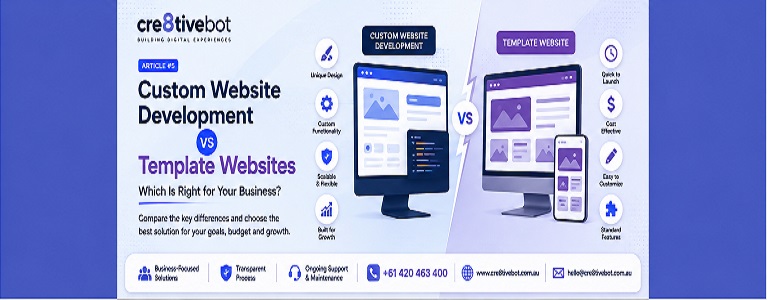
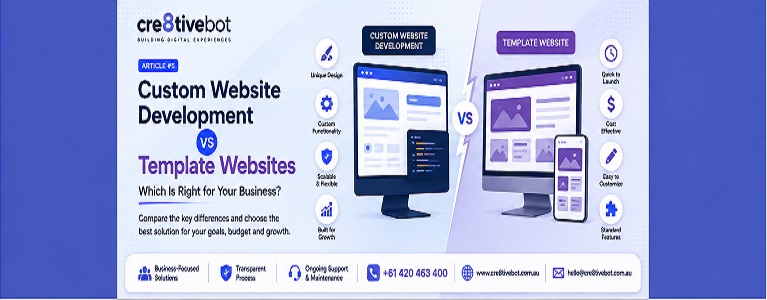
Custom Website Development vs Template Websites: Which Is Right for Your Business?
Choosing how to build a website is one of the first decisions a business needs to make. Some businesses choose a ready-made template because it can provide a quicker starting point, while others prefer custom website development to create a website specifically around their brand, customers and business processes.
There is no single solution that is right for every Australian business. The best option depends on your budget, functionality, branding, scalability and long-term objectives.
Cre8tivebot provides both customised and platform-based website development solutions, helping Australian businesses select an approach that fits their actual requirements.
Before choosing between the two options, it is useful to understand how custom website development differs from template-based website development.
What Is Custom Website Development?
Custom website development involves creating a website specifically around the requirements of a business.
Instead of relying entirely on a pre-designed layout, developers can create customised designs, functionality and integrations.
Custom website development may be suitable for:
- Growing businesses
- Large organisations
- B2B companies
- eCommerce businesses
- Membership platforms
- Online marketplaces
- Booking systems
- Customer portals
- Web applications
- Businesses with complex integrations
The main advantage of custom website development is flexibility.
What Is a Template Website?
A template website uses a pre-designed layout or theme as its foundation.
Platforms such as WordPress and Shopify offer thousands of themes and templates that businesses can customise to varying degrees.
Template websites can be suitable for:
- Startups
- Small businesses
- New businesses
- Simple service websites
- Businesses with limited budgets
- Businesses that need to launch quickly
Templates can reduce the amount of design and development work required, although the final website may have limitations depending on the chosen theme and platform.
Custom Website Development vs Templates
The biggest difference between the two approaches is flexibility.
With custom website development, the design and functionality can be built around specific requirements.
With a template, businesses generally work within an existing design framework.
This doesn’t mean templates are bad. For many small businesses, a well-selected template can provide a practical and cost-effective solution.
The important question is whether the platform and template can support your business now and as it grows.
Design Flexibility
Custom website development provides considerably more control over the visual appearance of a website.
A custom website can be designed around:
- Brand identity
- Target audience
- User experience
- Specific page layouts
- Conversion goals
- Product presentation
- Business processes
Template websites can also be customised, but the available options may depend on the theme.
If your business requires a highly distinctive digital experience, custom website development may provide greater flexibility.
Functionality and Features
Another important difference is functionality.
A template website generally provides standard features, while custom website development allows specialised features to be created around the business.
For example, a business may require:
- Custom booking systems
- Customer dashboards
- Membership functionality
- Complex product configurations
- Advanced search
- Custom calculators
- API integrations
- CRM integration
- ERP integration
- Automated workflows
If these requirements cannot be achieved effectively through standard plugins or applications, custom development may be a better option.
Website Development Speed
Template websites can often be launched faster because the basic design and functionality already exist.
This can be useful for a startup or small business that needs to establish an online presence quickly.
Custom website development generally requires more planning, design and development time.
The process can involve:
- Discovery
- Requirements analysis
- UX planning
- Custom design
- Development
- Testing
- Launch
For businesses with complex requirements, the additional time can be worthwhile because the final solution is designed around their specific needs.
Website Development Cost
Cost is another major consideration.
Template-based websites are often less expensive to develop because they can use existing themes and components.
Custom website development can require a larger initial investment because more work is involved in design, development and testing.
However, businesses should consider the total value rather than only the initial cost.
A low-cost template may become expensive if the business later needs extensive modifications that the template cannot easily support.
Conversely, a custom website may provide a stronger long-term foundation for a growing organisation.
Scalability
Scalability means the ability of a website to grow with the business.
A small company may initially need only five or ten pages. As it grows, it may require:
- More services
- More locations
- eCommerce
- Customer accounts
- Integrations
- Advanced reporting
- Additional functionality
Custom website development can provide greater control when designing for future requirements.
However, modern platforms such as WordPress and Shopify can also scale effectively when they are properly configured and managed.
Performance and Website Speed
Website performance depends on many factors, including hosting, images, code, plugins, applications and website architecture.
A template with excessive features or poorly optimised components can potentially affect performance.
Custom website development allows developers to build functionality more specifically around the project’s requirements.
However, custom development does not automatically guarantee a faster website. Performance still depends on the quality of development, hosting and ongoing optimisation.
SEO Considerations
Both custom and template websites can be optimised for search engines.
SEO-friendly development should consider:
- Website structure
- Page speed
- Mobile responsiveness
- URLs
- Internal linking
- Heading structure
- Metadata
- Image optimisation
- Crawlability
- Structured data
A template website can perform well in search when it is properly configured and supported by strong content and SEO.
Similarly, custom website development can provide greater control over technical architecture, but good development alone does not guarantee rankings.
For more information about planning and building a website, read our Website Development Process: From Planning to Launch guide.
Internal link: Article #4 – Website Development Process: From Planning to Launch
Suggested URL: /website-development-process-from-planning-to-launch/
Security
Website security should be considered regardless of the development approach.
Businesses should consider:
- SSL
- Secure hosting
- Strong passwords
- User permissions
- Software updates
- Backups
- Security monitoring
Template-based websites may rely heavily on themes, plugins or third-party applications, so these components need to be maintained.
Custom websites also require ongoing security management and updates.
Maintenance Requirements
Both approaches require maintenance.
Template websites may require:
- Theme updates
- Plugin updates
- Platform updates
- Security checks
- Backups
Custom websites may require:
- Software updates
- Security monitoring
- Bug fixes
- Custom functionality updates
- Server maintenance
- API maintenance
The maintenance requirements depend on the technology used and the complexity of the website.
Which Option Is Better for Small Businesses?
For many small businesses, a template-based website can be a practical starting point.
A business may not need expensive custom functionality during its early stages.
A professional WordPress or Shopify website using a carefully selected and customised theme can provide:
- Professional design
- Mobile responsiveness
- Content management
- Basic SEO functionality
- Lead generation
- eCommerce capabilities
However, if the business has specialised requirements, custom website development may still be appropriate.
Which Option Is Better for Large Businesses?
Larger organisations often have more complex requirements.
They may need:
- Multiple locations
- Advanced integrations
- Custom workflows
- Customer portals
- Enterprise eCommerce
- Complex databases
- Custom reporting
- CRM integration
- ERP integration
In these circumstances, custom website development can provide greater flexibility and control.
That doesn’t mean every large company needs a completely custom website. Platforms such as Shopify Plus, WordPress and other enterprise solutions can also provide scalable options.
The decision should be based on actual business requirements.
When Should You Choose a Template?
A template may be appropriate when:
- You have a limited budget
- You need a website quickly
- Your requirements are relatively simple
- You don’t need specialised functionality
- You are launching a new business
- Standard platform features meet your needs
For many Australian small businesses, this can be a sensible starting point.
When Should You Choose Custom Development?
Custom website development may be more appropriate when:
- Your business has unique requirements
- You need specialised functionality
- You require complex integrations
- You need a customer portal
- You operate a marketplace
- You need advanced workflows
- Standard themes cannot meet your design requirements
- You expect significant future growth
The goal should be to choose the simplest technology capable of achieving your business objectives.
Can WordPress Be Custom Developed?
Yes.
WordPress is not limited to pre-designed templates.
Developers can create custom WordPress themes, custom plugins and specialised functionality.
This means a business can use WordPress as the content management system while still benefiting from custom website development.
This can be useful when businesses want WordPress’s content management capabilities combined with a highly customised website.
Can Shopify Be Customised?
Yes.
Shopify allows businesses to customise themes, layouts, product pages and various aspects of their online stores.
Developers can also create custom functionality and integrate third-party systems.
For businesses with more advanced requirements, Shopify can provide a scalable eCommerce foundation without necessarily requiring a completely custom eCommerce platform.
How Cre8tivebot Can Help
Cre8tivebot provides website development solutions for Australian businesses based on their individual requirements.
Our services include:
- Custom website development
- WordPress development
- Shopify development
- WooCommerce development
- eCommerce development
- Business website development
- Website redesign
- Website migration
- API integrations
- CRM integrations
- SEO-friendly website development
- Website maintenance
We don’t believe every business needs the most complicated website possible. Our approach is to understand your objectives and recommend a practical solution that can provide value today while supporting future growth.
Custom Website Development or Template: Which Should You Choose?
There is no universal winner between custom and template websites.
A template can be an excellent choice for a small business that needs a professional online presence quickly and within a controlled budget.
Custom website development can be a better choice for businesses requiring specialised functionality, distinctive design, complex integrations or greater long-term flexibility.
The right decision should consider:
- Budget
- Business objectives
- Functionality
- Audience
- Timeframe
- Scalability
- Integrations
- Maintenance
- Future requirements
If you’re still at the planning stage, our Website Development Process: From Planning to Launch article explains how to move from initial requirements through to design, development, testing and launch.
Suggested internal link: /website-development-process-from-planning-to-launch/
For Australian businesses looking for professional website development, Cre8tivebot can help you choose between a customised solution and a platform-based website.
Contact Cre8tivebot to discuss your requirements and find a website development approach that fits your business.