


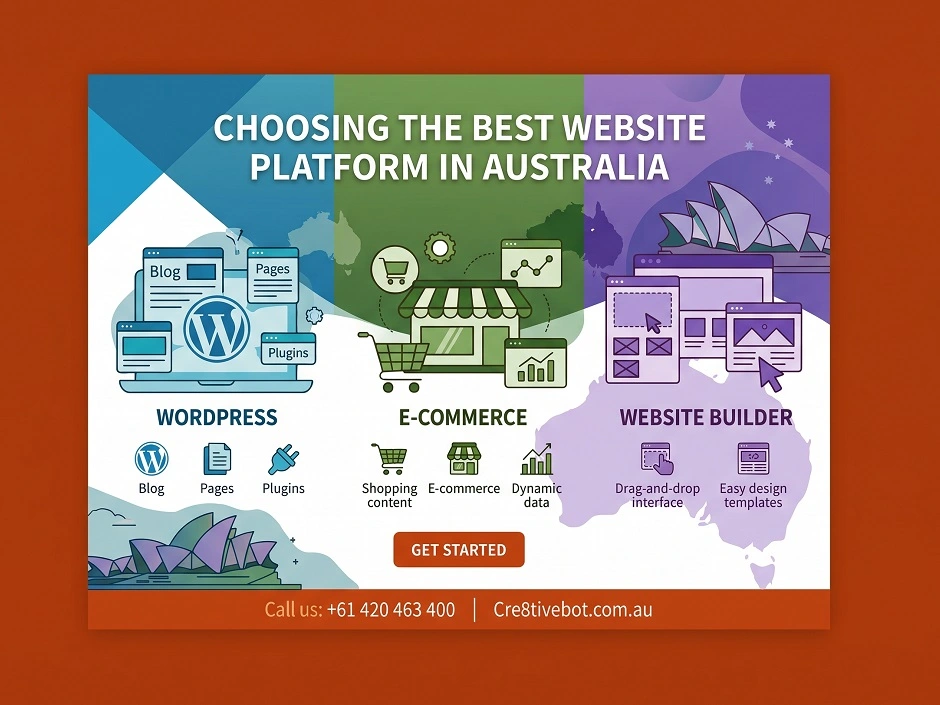
Choosing the Best Website Platform in Australia: The Definitive Business Guide
Launching or redesigning a digital presence is one of the most critical commercial decisions an enterprise will make. Across Australia’s bustling economic hubs, digital channels have shifted from passive brochures into full-scale operational engines. Whether you are running a boutique consultancy along Collins Street in Melbourne, an innovative hospitality brand in Fitzroy, or an expanding industrial supplier across Victoria, selecting the right technology underpins every transaction, customer interaction, and conversion.
At Cre8tivebot, our mission is to cut through the digital jargon and vendor hype to deliver sustainable digital infrastructure. We frequently meet business owners who invested thousands of dollars into sophisticated systems only to discover that their staff cannot update text, or that recurring monthly plugin subscriptions have spiralled out of hand.
Selecting the right framework is not merely a technical consideration; it dictates your customer acquisition costs, ongoing maintenance overheads, Australian Privacy Principle compliance, and search visibility. In this extensive guide, we will unpack the strategic factors involved in choosing the best website platform in Australia, with a practical focus on businesses operating within Melbourne and across Victoria.
The Modern Australian Digital Economy: Why Infrastructure Matters
The domestic digital market in Australia operates under unique dynamics. Australian consumers demonstrate exceptionally high mobile connectivity and an uncompromising expectation for near-instant site loading speeds. When an online shopper in South Yarra or an operational manager in Dandenong clicks an organic search result or paid social advertisement, they expect sub-two-second load times, intuitive mobile checkout experiences, and frictionless navigation.
Choosing poorly comes with direct operational penalties:
- Server Latency and Lost Revenue: Using hosted systems that maintain solely US or European server clusters without robust Australian edge-caching leads to noticeable latency, higher bounce rates, and reduced Google rankings.
- Excessive Ongoing Maintenance Costs: Complex open-source software installations often demand persistent developer patches, leading to unexpected technical debt.
- Platform Migration Bottlenecks: Migrating away from an inflexible, closed-wall builder two years down the track costs substantially more than architecting the solution correctly from day one.
To establish sustainable online growth, businesses must approach this choice systematically. Understanding the best website platform in Australia requires an honest assessment of your business model, internal technical literacy, and long-term scalability requirements.
Core Criteria for Australian and Victorian Enterprises
Before evaluating individual systems, you must establish an objective evaluation rubric. When Cre8tivebot audits digital strategies for Melbourne enterprises, we evaluate platforms against six core operational criteria:
1. Domestic Infrastructure and Edge Performance
Google’s Core Web Vitals heavily weigh performance metrics like Largest Contentful Paint (LCP) and Interaction to Next Paint (INP). Platforms with direct local points of presence (PoP) in Sydney and Melbourne or deep integration with top-tier content delivery networks ensure your digital assets are delivered locally rather than making transatlantic network hops.
2. Australian Payment, Shipping, and Regulatory Ecosystems
A platform suited to North American retail may fall flat when applied to Australian operations. Local businesses require seamless out-of-the-box support for domestic payment gateways (Stripe, Square, eWAY, Commonwealth Bank Simplify), flexible Buy Now Pay Later (BNPL) integrations (Afterpay, Zip), and live shipping rate calculators for Australia Post, StarTrack, and Sendle. Furthermore, your platform must support compliance with the Australian Privacy Principles (APPs) under the Privacy Act 1988.
3. Total Cost of Ownership (TCO)
Do not evaluate platform costs on monthly hosting fees alone. Calculate the three-year Total Cost of Ownership:
- Core software licensing or subscription tier
- Payment gateway transaction surcharges
- Essential application and plugin fees (SEO modules, form builders, security firewalls)
- Routine developer retainer costs for patching, backups, and security remediation
- In-house staff training and operational administration time
4. Search Engine Optimisation (SEO) and Local Search Readiness
Winning local search results in competitive urban environments like Melbourne requires granular control over technical SEO parameters. You need native or easily manageable access to canonical tags, XML sitemaps, robots.txt directives, structured schema markup (LocalBusiness and Product schema), clean URL structures, and responsive image compression.
5. Content Autonomy vs Technical Overhead
Who will update your site weekly? If changing a promotional banner or uploading a case study requires a ticket to an external agency, marketing momentum stalls. Conversely, if an interface is completely unconstrained, non-technical team members can inadvertently break layout grids and mobile responsiveness.
6. Integration and Architectural Extensibility
Your website cannot live in isolation. It must communicate cleanly with your Customer Relationship Management (CRM) platform (such as HubSpot, Salesforce, or Zoho), automated email engines (Klaviyo, Mailchimp), inventory management tools (DEAR, Unleashed), and local POS systems.
Detailed Platform Evaluation: Choosing the Best Website Platform in Australia
To make an informed decision, let us systematically examine the top website frameworks currently powering the Australian digital economy.
+------------------+---------------------+---------------------+---------------------+
| Platform         | Best Suited For     | Technical Overhead  | Scalability Rating  |
+------------------+---------------------+---------------------+---------------------+
| Shopify          | Pure E-commerce     | Low                 | Very High           |
| WordPress / Woo  | Content & Editorial | Moderate to High    | High (Self-managed) |
| Webflow          | Custom Visual B2B   | Low to Moderate     | High (Design-led)   |
| Squarespace / Wix| Sole Traders / Micro| Minimal             | Low to Moderate     |
| Custom / Next.js | Bespoke Web Apps    | High (Dedicated Dev)| Maximum             |
+------------------+---------------------+---------------------+---------------------+
1. Shopify: The Undisputed Retail Powerhouse
For retail and consumer goods brands, Shopify remains a primary candidate when exploring the best website platform in Australia. From fledgling Melbourne design labels working out of Brunswick to high-volume distribution warehouses across Moorabbin, Shopify offers a remarkably robust, fully hosted commerce engine.
Key Strengths:
- Flawless Australian Checkout: Shopify’s native checkout flow is among the highest-converting globally. It supports Shop Pay, Apple Pay, Google Pay, Afterpay, and Zip out of the box with zero complex configuration.
- Australia Post & Regional Fulfilment Integration: The platform connects smoothly with local courier software, automated parcel locker systems, and multi-location inventory across regional brick-and-mortar storefronts.
- Zero Server Headaches: Because Shopify handles server scaling, security patches, PCI-DSS compliance, and domestic traffic spikes during Black Friday/Cyber Monday (BFCM) or Boxing Day sales, your internal team can focus on marketing and order fulfilment.
Trade-offs to Consider:
- Blogging and Editorial Limitations: Shopify’s native blogging capabilities are rudimentary compared to content-first engines.
- Subscription Stacking: Advanced reporting, specialised product options, and third-party integrations often require paid monthly apps, which can rapidly inflate monthly operational costs.
- Checkout Customisation Barriers: Unless you are on the premium Shopify Plus tier, deep alterations to the checkout sequence are restricted.
2. WordPress & WooCommerce: The Flexible Heavyweight
WordPress powers over 40% of the active internet and remains a standard fixture across the Australian commercial sector. For service-oriented businesses, publishers, and companies requiring deeply tailored database structures, WordPress—paired with WooCommerce for transactional needs—represents an immensely versatile choice.
Key Strengths:
- Absolute Data Ownership: You own every line of code and every record in your database. You can host with high-performance Australian managed hosts (such as WP Engine’s Sydney servers or dedicated local AWS clusters), ensuring sovereign data storage and low ping times.
- Limitless Customisation: With access to thousands of APIs, custom post types, and bespoke themes, any operational process—from automated Victorian trade quote builders to complex membership portals—can be engineered.
- Superb Organic SEO Architecture: When paired with tools like Rank Math or Yoast, WordPress offers unparalleled fine-grained control over site taxonomy, schema definitions, and indexation controls.
Trade-offs to Consider:
- Maintenance Responsibility: WordPress is not a “set-and-forget” platform. It requires proactive weekly updates to plugins, PHP runtime environments, database optimisations, and web application firewall (WAF) configurations to prevent malicious breaches.
- Performance Bloat: Unchecked installations loaded down with unoptimised commercial themes and conflicting plugins suffer from severe code bloat, leading to poor mobile Core Web Vitals scores.
3. Webflow: The Visual-First Powerhouse for B2B
Over the past five years, Webflow has emerged as a front-runner for design-conscious service firms, professional corporate practices, and modern tech enterprises. For businesses seeking clean, semantic code output combined with intuitive drag-and-drop editorial freedom, Webflow frequently earns its reputation as the best website platform in Australia for corporate B2B.
Key Strengths:
- Clean Semantic Code Output: Unlike legacy site builders, Webflow writes clean, standard W3C-compliant HTML, CSS, and JavaScript as visual layouts are constructed, delivering blistering rendering speeds.
- Hosted Enterprise-Grade Infrastructure: Built directly upon Amazon Web Services (AWS) and globally distributed via Fastly CDN, Webflow sites benefit from native edge routing across Australian capital cities.
- The Visual CMS Editor: Webflow cleanly decouples layout design from daily content management. Marketing teams and content writers can safely update text, publish blog posts, and add case studies on the live visual page without any possibility of accidentally breaking layout grids or global styling.
Trade-offs to Consider:
- Complex E-commerce Limitations: While Webflow provides native e-commerce capabilities for boutique catalogues, it lacks the multi-currency, granular tax, and high-volume logistics management required by large-scale Australian merchants.
- Learning Curve for Initial Setup: Designing natively in Webflow requires a solid conceptual understanding of the CSS box model and flexbox/grid layout logic.
4. All-in-One Site Builders (Squarespace, Wix)
For sole traders, local trades, or micro-businesses taking their very first digital steps, entry-level website builders offer an accessible pathway to getting online quickly.
Key Strengths:
- Low Barrier to Entry: Drag-and-drop templates allow a non-technical business owner to assemble a clean, functional five-page site over a weekend.
- Inclusive Bundling: Hosting, SSL certificates, domain management, and essential styling are packaged into a single predictable monthly or annual bill.
Trade-offs to Consider:
- Restricted Technical SEO Control: Advanced schema customisation, fine-tuned script execution order, and custom database relationships are difficult or impossible to deploy.
- Limited Architectural Scalability: As your Victorian customer base grows and your operational processes demand custom CRM two-way syncing or automated portals, these platforms often hit an immovable ceiling, necessitating a complete rebuild.
5. Custom Jamstack / Headless Web Applications (Next.js, Headless CMS)
For large enterprises, fast-moving venture-backed startups, and high-volume transactional platforms, decoupling the frontend user interface from the backend content management engine represents the pinnacle of digital architecture.
Key Strengths:
- Unsurpassed Page Speed: Static site generation (SSG) and incremental static regeneration (ISR) compile pages into lightweight static files served directly from nearest Australian CDN nodes within milliseconds.
- Complete Omnichannel Flexibility: A single headless CMS backend (such as Sanity or Strapi) can concurrently distribute content across your main web property, native iOS/Android applications, and smart in-store digital displays.
- Maximum Security: Without a traditional direct database or standard CMS backend exposed to the open web, the available attack surface for malicious automated scripts is practically eliminated.
Trade-offs to Consider:
- Substantial Initial Capital Investment: Engineering a bespoke headless architecture requires skilled frontend engineers, continuous integration pipelines, and dedicated technical oversight.
- Longer Build Timelines: Custom software development naturally demands longer design, engineering, and quality assurance cycles compared to commercial off-the-shelf software.
Comparing the Platforms
+------------------------------------+--------------------------+-----------------------+------------------------+
| Selection Factor                   | Shopify                  | WordPress             | Webflow                |
+------------------------------------+--------------------------+-----------------------+------------------------+
| Best Business Model                | Retail & E-commerce      | Content & Publishing  | B2B Corporate Services |
| Setup Complexity                   | Low to Moderate          | Moderate to High      | Moderate               |
| Ongoing Maintenance Needs          | Zero (Fully Hosted)      | High (Patches/Security| Minimal (Managed CDN)  |
| Australian Gateway Integration     | Native, Exceptional      | Highly Customisable   | Moderate               |
| Visual Content Editing             | Strict Form-based        | Block-based (Gutenberg| True Visual Inline     |
| Average 3-Year Operational Cost    | Mid to High (App fees)   | Mid (Host + Dev time) | Mid (Predictable plan) |
+------------------------------------+--------------------------+-----------------------+------------------------+
The Victorian Commercial Landscape: Choosing the Best Website Platform in Australia
Victoria’s economic landscape is distinctly multifaceted. Melbourne is widely recognised as the design, culinary, and creative capital of Australia, alongside housing massive manufacturing corridors in the south-east and west, thriving bio-tech precincts in Parkville, and premium financial institutions in the central CBD.
At Cre8tivebot, our work across the Victorian market has highlighted how geographic and commercial context shapes platform choice:
The High-End Melbourne Hospitality & Retail Sector
In vibrant commercial strips across South Yarra, Richmond, and Collingwood, brand aesthetics and tactile design are paramount. A boutique footwear retailer or specialty coffee roaster cannot afford a generic, uninspiring template.
- For direct-to-consumer sales, Shopify provides the robust framework necessary to handle high-volume local click-and-collect orders, integrated POS setups for physical shopfronts, and automated local courier integration.
- Pairing Shopify’s checkout engine with a visually distinct frontend theme guarantees that the refined visual identity of the brand is accurately reflected online.
Professional Services in the Melbourne CBD
Corporate law firms, engineering consultancies, and private equity offices clustered around William and Collins Streets require authority, trust, and frictionless lead generation. Their sites require sophisticated case study libraries, partner directories, and secure integration with enterprise CRMs.
- For these organisations, Webflow often stands out as the best website platform in Australia. It delivers pristine corporate presentation without the security vulnerabilities and perpetual plugin patching that risk taking a corporate WordPress site offline during critical business hours.
Industrial and B2B Manufacturing Across Outer Victoria
From logistics firms in Truganina to structural fabrication workshops in Dandenong, industrial enterprises have entirely different requirements. They often feature extensive technical specification tables, downloadable PDF catalogues, and structured request-for-quote (RFQ) lead flows.
- WordPress frequently remains the preferred platform for these organisations, provided it is deployed on dedicated local Australian servers. Its ability to handle complex relational data, gated trade pricing tiers, and custom quote calculation logic provides industrial operations with the structural depth their customers require.
Technical Considerations Specific to the Australian Market
Regardless of which framework you ultimately deploy, several non-negotiable technical standards apply directly to operating in the domestic Australian marketplace:
[Australian User Device]
        │
        ▼ (Low-Latency Local DNS Resolution)
[Sydney / Melbourne Edge Server]
        │
        ├── Static Assets (Fastly / Cloudflare Local CDN)
        └── Dynamic Queries ──► [Encrypted Sovereign AU Database]
                                       │
                                       ▼
                     [Compliant Domestic Gateways]
                     (Stripe AU / eWAY / Afterpay)
1. The ‘.com.au’ Domain and DNS Infrastructure
Operating a commercial entity in Australia almost always calls for a trusted .com.au or .net.au domain namespace. Registered under the strict authority of the .au Domain Administration (auDA), these domains require an active Australian Business Number (ABN) or Australian Company Number (ACN).
Your domain’s DNS routing must resolve swiftly through local nameservers. Deploying DNS management through premium providers like Cloudflare with local Anycast nodes in Melbourne, Sydney, Brisbane, and Perth ensures that lookup times remain under 20 milliseconds across the country.
2. Australian Privacy Principles (APPs) and Data Sovereignty
Under the Privacy Act 1988, Australian enterprises must take reasonable steps to protect personal information from misuse, interference, loss, and unauthorised access. If your site processes customer enquiries, quote requests, or financial transactions, your platform must support:
- Transport Layer Security (TLS 1.3) data encryption across all endpoints
- Transparent privacy notification banners explaining data collection practices
- Secure, access-controlled databases that store user details in domestic or compliant cloud jurisdictions
3. Core Web Vitals and Mobile Networks
A significant portion of regional Victoria connects to digital platforms via fluctuating 4G/5G mobile links or regional NBN wireless. Heavy, unoptimised platform themes that download megabytes of uncompressed JavaScript will stutter and fail on these connections. When selecting your framework, evaluate how aggressively it compresses media into next-gen formats (WebP/AVIF), defers non-critical CSS/JS, and minimises Total Blocking Time (TBT).
Common Pitfalls When Selecting a Platform
Throughout our agency tenure, Cre8tivebot has conducted digital health checks on hundreds of business assets. Time and again, we see Australian enterprises fall into the same strategic traps:
Pitfall 1: Choosing Based Purely on Competitor Emulation
Just because a major global enterprise uses a custom headless stack or a competitor runs an old WordPress build does not make it appropriate for your operating model. Base your decision on your team’s day-to-day workflow, your internal technical capabilities, and your budget for ongoing maintenance.
Pitfall 2: Over-reliance on Third-Party Plugins
A classic symptom of a poorly planned build is the “plugin stack tower.” If a site requires 45 separate third-party plugins to achieve basic functionality, it will inevitably break. Every plugin introduced is an additional security vector, a potential database bottleneck, and an ongoing financial liability when developers change their subscription models.
Pitfall 3: Neglecting Ongoing Maintenance Budgets
Building a website is not a one-off capital expenditure; it is an active business asset. If you select self-hosted open-source software, you must factor in ongoing technical retainers for updates, testing, and security hardening. If your balance sheet prefers a predictable, flat operating expense, a hosted software-as-a-service (SaaS) platform like Webflow or Shopify is invariably the more prudent commercial route.
Practical Decision Framework: Which System Fits Your Needs?
To determine the best website platform in Australia for your specific requirements, run your project through this four-step diagnostic:
Scenario A: Direct-to-Consumer (D2C) Retailer
Primary Objective: Maximum conversion, frictionless payments, streamlined logistics.
- Verdict:Shopify is the unequivocal choice. The speed of deployment, battle-tested checkout security, and rich Australian logistics integration provide an immediate commercial advantage.
Scenario B: High-Growth B2B Corporate or Professional Services
Primary Objective: Premium brand presentation, interactive case studies, rapid visual editing for marketing staff.
- Verdict:Webflow stands out as the optimal platform. It delivers bespoke, agency-calibre frontend polish with an intuitive, isolated visual CMS that safeguards brand design integrity.
Scenario C: Complex Custom Database, Directory, or Custom Portal
Primary Objective: Deep data customisation, proprietary workflows, complete code ownership.
- Verdict:WordPress (Custom Engineered) or a Bespoke Next.js Application. Provided you partner with an experienced development firm and deploy on high-performance Australian cloud servers, this route offers boundless long-term flexibility.
How Cre8tivebot Approaches Strategic Platform Selection
At Cre8tivebot, we do not believe in one-size-fits-all digital solutions. A technology stack should be selected to serve the client’s business goals—never the other way around.
When partnering with Australian and Victorian enterprises, our architectural process follows a structured path:
- Strategic Discovery: We audit your existing operational ecosystem, current sales funnels, internal staff capabilities, and five-year commercial trajectory.
- Architecture Mapping: We weigh the functional requirements against total cost of ownership, speed benchmarks, and security constraints to select the platform best aligned with your needs.
- Bespoke Engineering & UI/UX: We construct custom, accessible, and responsive user experiences that honour your visual brand identity while maintaining lightning-fast performance across Australian mobile networks.
- Localised Search Optimisation: We integrate schema markup, local citation readiness, and high-converting copy tailored to Australian audiences.
- Team Empowerment: We provide comprehensive training and visual documentation, ensuring your team has total confidence managing daily content without ongoing reliance on external agencies.
The digital landscape in Australia moves rapidly. Ensuring your enterprise rests on resilient, high-speed, and secure web infrastructure is the single most valuable operational investment you can make for your brand’s future. By taking a clear-eyed, data-driven approach to choosing your platform, you lay a solid foundation for sustainable growth, exceptional user experiences, and dominant market visibility across Melbourne and the wider Australian economy.