
Headless CMS & API-Driven Architecture Explained: The Future of Web Development for Australian Businesses
The way websites are built has fundamentally changed. For decades, businesses relied on monolithic content management systems — platforms like WordPress or Drupal — where the content backend and the frontend presentation were tightly coupled together. It worked well enough for a simpler digital world. But today, Australian businesses operate across websites, mobile apps, digital kiosks, voice assistants, and more. Managing content across all these channels with a traditional CMS is slow, inflexible, and increasingly costly.
Enter the headless CMS and API-driven architecture. At Cre8tivebot, Melbourne’s specialist web development agency, we’re helping businesses across Australia modernise their digital infrastructure with these powerful approaches. In this article, we’ll break down exactly what headless CMS and API-driven architecture mean, why they’re gaining rapid traction in Australia, and how they can transform the way you manage and deliver content.
What Is a Traditional (Monolithic) CMS?
To understand headless CMS, it helps to first understand what it replaces. A traditional CMS like WordPress is a monolithic system: the content management layer (where you write and manage content) and the presentation layer (what visitors see in their browser) are built as one unified system. Templates, themes, and plugins are all tightly intertwined with the database and content structure.
This works well for straightforward websites, but it creates significant limitations. The frontend is constrained by the CMS’s templating language. Performance can suffer due to plugin bloat. Scaling across multiple channels — say, pushing the same content to your website, your iOS app, and a digital display in your Melbourne store — requires duplicating content or building expensive workarounds. And because everything is coupled, a change to the backend can inadvertently affect the frontend.
What Is a Headless CMS?
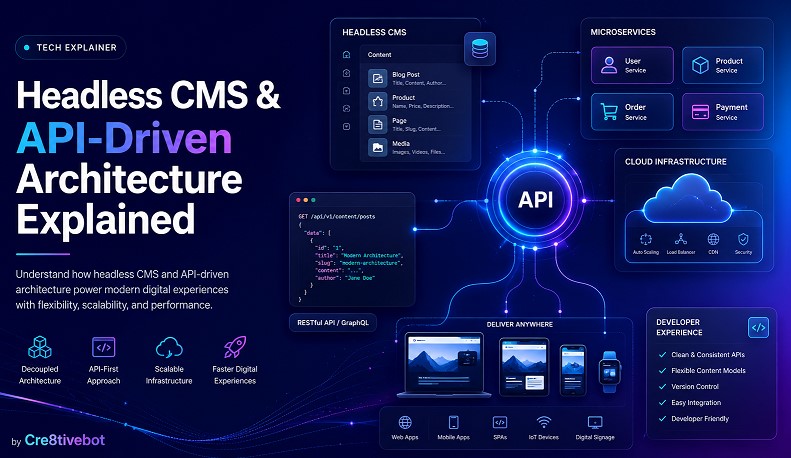
A headless CMS decouples the content management backend from the presentation frontend. The ‘head’ — meaning the frontend that displays content to users — is removed from the equation entirely. What remains is a powerful content repository with a clean API (usually a REST API or GraphQL API) that delivers content as raw data, typically in JSON format.
This means your content is no longer tied to any specific presentation layer. Instead, any frontend application — a React website, a mobile app, a smart TV interface, a voice assistant, a digital billboard — can request content from the headless CMS via the API and display it however it chooses. Your content becomes truly channel-agnostic and future-proof.
Popular headless CMS platforms that Cre8tivebot works with include Contentful, Sanity, Strapi, Directus, and DatoCMS. Each offers different strengths depending on your business size, content complexity, and technical requirements.
What Is API-Driven Architecture?
API-driven architecture is the broader development philosophy that underpins headless CMS. In an API-driven system, every component of your digital ecosystem communicates via APIs — standardised interfaces that allow different software systems to talk to each other reliably and securely.
Instead of one monolithic application doing everything, an API-driven architecture connects a constellation of best-in-class services: a headless CMS for content, a separate e-commerce engine for transactions, a payment gateway for processing, a CRM for customer data, a marketing automation tool for emails, and so on. Each service does one thing exceptionally well, and they all communicate via APIs.
This composable approach — sometimes called a ‘MACH architecture’ (Microservices, API-first, Cloud-native, Headless) — is rapidly becoming the preferred model for modern web development among forward-thinking Australian businesses.
Why Australian Businesses Are Making the Switch
We’re seeing growing demand for headless CMS and API-driven architecture from clients across Melbourne, Sydney, Brisbane, and beyond. Here’s why:
- Omnichannel content delivery: Australian brands with both digital and physical presences need to push content across websites, apps, in-store screens, and social platforms simultaneously. A headless CMS makes this seamless.
- Speed and performance: Headless frontends built with modern frameworks like Next.js or Gatsby load significantly faster than traditional CMS-driven sites. Faster sites rank better on Google and convert more visitors into customers.
- Developer freedom: With the backend separated from the frontend, developers can choose the best tools for the job rather than being constrained by a CMS’s built-in templating system. This leads to cleaner code and more innovative solutions.
- Scalability: API-driven systems scale horizontally. You can handle traffic spikes — say, during a major Australian retail event like Click Frenzy or Boxing Day sales — without your entire platform grinding to a halt.
- Security: A headless CMS reduces the attack surface of your website. Because the backend database is not directly exposed to the web (it communicates only via API), there are fewer vulnerabilities compared to traditional CMS installations.
- Content reuse and consistency: Write content once in your headless CMS and distribute it consistently across every channel. No more copying and pasting content between a website CMS, an app backend, and an email platform.
The Technical Stack: How Cre8tivebot Builds Headless Solutions
At Cre8tivebot, our headless and API-driven projects typically follow a modern JAMstack or Next.js-based architecture. Here’s how a typical project breaks down:
- Content layer: We configure a headless CMS (often Sanity or Contentful) to model your content structure — blog posts, products, team members, services, case studies — with custom fields and relationships.
- API layer: The CMS exposes content via a GraphQL or REST API. We design efficient API queries that fetch only the data needed for each page, minimising payload size and maximising performance.
- Frontend layer: We build the presentation layer using Next.js (our preferred framework), which supports static site generation (SSG), server-side rendering (SSR), and incremental static regeneration (ISR). This gives your site extraordinary speed while keeping content fresh.
- Deployment: We deploy on cloud platforms like Vercel or AWS, enabling global CDN distribution so your Australian audience experiences fast load times regardless of which state they’re in.
- Third-party integrations: Via APIs, we connect your site to payment gateways (Stripe, Afterpay), CRMs (HubSpot, Salesforce), marketing tools (Klaviyo, Mailchimp), and analytics platforms.
Is Headless CMS Right for Your Business?
Headless CMS and API-driven architecture are powerful, but they’re not the right fit for every situation. A simple five-page brochure website for a local Melbourne trade business probably doesn’t need the complexity of a headless setup. However, if any of the following apply to your business, it’s worth a serious conversation with the Cre8tivebot team:
- You’re managing content across multiple channels or platforms.
- Your website is slow and your traditional CMS is over-loaded with plugins.
- You need a mobile app that shares content with your website.
- You’re experiencing scaling challenges during high-traffic periods.
- Your marketing team needs to publish content without relying on developers for every update.
- You’re planning significant growth and need a digital foundation that can evolve with you.
The Content Editor Experience
One concern businesses often raise is whether a headless CMS is harder for non-technical content editors to use. Modern headless platforms have invested heavily in editorial UX. Sanity, for example, offers a real-time collaborative editing interface. Contentful provides a clean, intuitive content modelling and publishing workflow. At Cre8tivebot, we configure and customise the editorial interface so your team can manage content confidently without needing to understand the underlying technology.
We also build custom previews so editors can see exactly how their content will appear on the live site before publishing — eliminating the guesswork that sometimes comes with decoupled systems.
The Cost and Timeline Reality
It’s important to be transparent: headless CMS and API-driven projects typically require a higher initial investment than a standard WordPress or Squarespace build. The architecture is more sophisticated, and the development time is longer. However, the total cost of ownership over three to five years is often lower. You avoid ongoing plugin licences, security patches for a bloated CMS, and costly performance fixes. And because the architecture is modular, you can add or swap out components without rebuilding the entire system.
For established Australian businesses and growing startups with genuine multi-channel needs, the ROI on a well-executed headless build is compelling. Cre8tivebot provides transparent project scoping and phased development options to make this technology accessible to businesses at different stages of growth.
Partner with Cre8tivebot for Your Headless Journey
The shift to headless CMS and API-driven architecture is one of the most significant evolutions in web development in the past decade. For Australian businesses that want to stay ahead of the curve — delivering faster, more flexible, and more scalable digital experiences — it represents the future of how content is managed and delivered.
At Cre8tivebot, our Melbourne-based team combines deep technical expertise with a genuine understanding of Australian business needs. We don’t just build websites — we build digital foundations that grow with you. From initial discovery and architecture planning through to development, testing, and training, we’re your partner at every step.
Ready to explore what headless CMS and API-driven architecture could do for your business? Reach out to the Cre8tivebot team in Melbourne today for a no-obligation consultation.